


Page 78 - RUT Publisher
P. 78
Life Science Research and Sustainable Development                                   ISBN: 978-98-84663-33-9


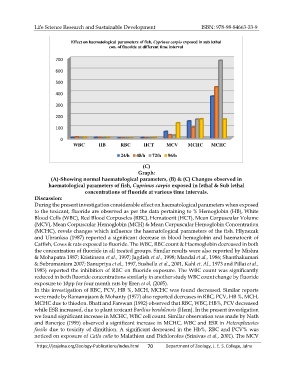
                               Effect on haematological parameters of fish, Cyprinus carpio exposed in sub lethal
                                               con. of fluoride at different time interval

                        700

                        600

                        500

                        400

                        300

                        200

                        100

                          0
                                WBC       HB       RBC       HCT       MCV      MCHC     MCHC

                                                   24/h   48/h   72/h  96/h

                                                             (C)
                                                           Graph:
                      (A)-Showing normal haematological parameters, (B) & (C) Changes observed in
                     haematological parameters of fish, Cyprinus carpio exposed in lethal & Sub lethal
                                     concentrations of fluoride at various time intervals.
               Discussion:
               During the present investigation considerable effect on haematological parameters when exposed
               to the toxicant, fluoride are observed as per the data pertaining to % Hemoglobin (HB), White
               Blood Cells (WBC), Red Blood Corpuscles (RBC), Hematocrit (HCT), Mean Corpuscular Volume
               (MCV), Mean Corpuscular Hemoglobin (MCH) & Mean Corpuscular Hemoglobin Concentration
               (MCHC), revels changes which influence the haematological parameters of the fish. Hlynezak
               and Ubranksa (1987) reported a significant decrease in blood hemoglobin and haematocrit of
               Catfish, Cows & rats exposed to fluoride. The WBC, RBC count & Haemoglobin decreased in both
               the concentration of fluoride in all treated groups. Similar results were also reported by Mishra
               & Mohapatra 1987; Kristinson et al., 1997; Jagdish et al., 1998; Mandal et al., 1986; Shanthakumari
               & Subramaniam 2007; Banupriya et al., 1997, Sushella et al., 2001, Kahl et. Al., 1973 and Pillai et al.,
               1985) reported the inhibition of RBC on fluoride exposure. The WBC count was significantly
               reduced in both fluoride concentrations similarly in another study WBC count change by fluoride
               exposure to 10pp for four month rats by Eren et al, (2005).
               In this investigation of RBC, PCV, HB %, MCH, MCHC was found decreased. Similar reports
               were made by Ramanujaam & Mohanty (1977) also reported decreases in RBC, PCV, HB %, MCH,
               MCHC due to thiodon. Bhatt and Farswan (1992) observed that RBC, WBC, HB%, PCV decreased
               while ESR increased, due to plant toxicant Barilius bendalensis (Hem). In the present investigation
               we found significant increase in MCHC, WBC cell count. Similar observation was made by Nath
               and Banerjee (1995) observed a significant increase in MCHC, WBC and ESR in Heteropheustes
               fossils due to toxicity of dimithion. A significant decreased in the Hb%, RBC and PCV% was
               noticed on exposure of Catla catla to Malathion and Dichlorofos (Srinivas et al., 2001). The MCV

                https://jesjalna.org/Zoology-Publications/index.html   70   Department of Zoology, J. E. S. College, Jalna

