


Page 73 - RUT Publisher
P. 73
Life Science Research and Sustainable Development                                   ISBN: 978-98-84663-33-9

                   17      Charadriformes Scolopacidae              Tringa ochropus                  R
                   18      Charadriformes Scolopacidae              Limosa limosa                    R
                   19      Charadriformes Scolopacidae             Tringa nebularia                  R
                   20      Pelecaniformes Phalcrocoracidae         Phalacrocorax fusicollis          R
                   21      Pelecaniformes Phalacrocoracidae        Phalacrocorax niger              RM
                   22      PelecaniformesArdeidae                  Ardea alba                        R
                   23      Pelecaniformes Ardeidae                 Ardea purpurea                    R
                   24      Ansariformes  Anatidae                  Anas poicillorhyncha              R
                   25      Ansariformes  Anatidae                  Netapus coromandalianus           R
                   26      Ansariformes  Anatidae                  Netta rufina                    WM
                   27      Ansariformes  Anatidae                  Anas platyrhynchos                R
                   28      Coraciformes coraciidae                 Coracias benghalensis           WM
                   29      CoraciformesAlcedinidae                 Alcedo atthis                     R
                   30      Cuculiformes cuculidae                  Eudynamys scolopaceus             R
                   31      Cuculiformes cuculidae                  Centropus sinensis                R
                   32      Columbiformes Columbidae                Spilopelia chinensis              R
                   33      Columbiformes Columbidae                Columba livia                     R

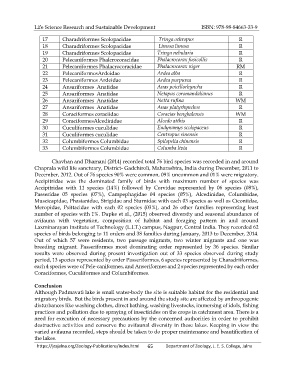
                       Chavhan and Dhamani (2014) recorded total 76 bird species was recorded in and around
               Chaprala wild life sanctuary, District- Gadchiroli, Maharashtra, India during December, 2011 to
               December, 2012. Out of 76 species 90% were common, 09% uncommon and 01% were migratory.
               Accipitridae  was  the  dominated  family  of  birds  with  maximum  number  of  species  was
               Accipitridae  with  11  species  (14%)  followed  by  Corvidae  represented  by  06  species  (08%),
               Passeridae  05  species  (07%),  Campephagidae  04  species  (05%),  Alcedinidae,  Columbidae,
               Muscicapidae, Phasianidae, Strigidae and Sturnidae with each 03 species as well as Ciconiidae,
               Meropidae,  Psittacidae  with  each  02  species  (03%),  and  26  other  families  representing  least
               number of species with 1%. Dapke et al., (2015) observed diversity and seasonal abundance of
               avifauna  with  vegetation,  composition  of  habitat  and  foraging  pattern  in  and  around
               Laxminarayan Institute of Technology (L.I.T.) campus, Nagpur, Central India. They recorded 62
               species of birds belonging to 11 orders and 38 families during January, 2013 to December, 2014.
               Out  of  which  57  were  residents,  two  passage  migrants,  two  winter  migrants  and  one  was
               breeding  migrant.  Passeriformes  most  dominating  order  represented  by  36  species.  Similar
               results  were  observed  during  present  investigation  out  of  33  species  observed  during  study
               period, 13 species represented by order Passeriformes, 6 species represented by Charadriiformes,
               each 4 species were of Pele-caniformes, and Anseriformes and 2 species represented by each order
               Coraciformes, Cuculiformes and Columbiformes.

               Conclusion
               Although Padmavati lake is small water-body the site is suitable habitat for the residential and
               migratory birds.  But the birds present in and around the study site are affected by anthropogenic
               disturbances like washing clothes, direct bathing, washing livestocks, immersing of idols, fishing
               practices and pollution due to spraying of insecticides on the crops in catchment area. There is a
               need for execution of necessary precautions by the concerned authorities in order to prohibit
               destructive activities and conserve the avifaunal diversity in these lakes. Keeping in view the
               varied avifauna recorded, steps should be taken to do proper maintenance and beautification of
               the lakes.

                https://jesjalna.org/Zoology-Publications/index.html   65   Department of Zoology, J. E. S. College, Jalna

