


Page 69 - RUT Publisher
P. 69
Life Science Research and Sustainable Development                                   ISBN: 978-98-84663-33-9

               future. The wildlife will soon face major negative side effects and thus the lungs of Mumbai will
               lose their charm.

               Well as a solution the government initially proposed a plan to shift it to kanjurmarg salt pan land
               but the financial loss the state would face because of relocating is a major issue. Not only will the
               relocating solution increase the cost but also will ultimately delay the project’s completion.
               Instead, the MMRC can implement the strategies DMRC i.e, the Delhi metro Rail corporation
               used. One of India's most effective suburban rail systems, the Delhi Metro connects areas on
               different ends of the national capital region along a network of 377 kilometers (NCR).
               The Delhi Metro claims  that  the  project was completed with  careful  planning  that  addresses
               numerous concerns associated with deforestation and other environmental aspects.
               Measures taken by the DMRC are as follows:

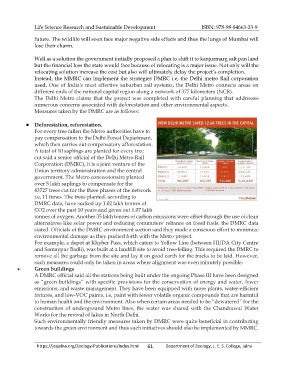
            ●  Deforestation, reforestation.
               For every tree fallen the Metro authorities have to
               pay compensation to the Delhi Forest Department,
               which then carries out compensatory afforestation.
               A total of 10 saplings are planted for every tree
               cut said a senior official of the Delhi Metro Rail
               Corporation (DMRC), it is a joint venture of the
               Union territory administration and the central
               government. The Metro concessionaire planted
               over 5 lakh saplings to compensate for the
               43727 trees cut for the three phases of the network
               i.e, 11 times. The trees planted, according to
               DMRC data, have sucked up 1.02 lakh tonnes of
               CO2 over the past 10 years and given out 1.07 lakh
               tonnes of oxygen. Another 35 lakh tonnes of carbon emissions were offset through the use of clean
               alternatives like solar power and reducing commuters' reliance on fossil fuels, the DMRC data
               stated. Officials of the DMRC environment section said they made a conscious effort to minimize
               environmental damage as they pushed forth with the Metro project.
               For example, a depot at Khyber Pass, which caters to Yellow Line (between HUDA City Centre
               and Samaypur Badli), was built at a landfill site to avoid tree-felling. This required the DMRC to
               remove all the garbage from the site and lay it on good earth for the tracks to be laid. However,
               such measures could only be taken in areas where alignment was even minutely possible.
        ●      Green buildings
               A DMRC official said all the stations being built under the ongoing Phase III have been designed
               as “green buildings” with specific provisions for the conservation of energy and water, fewer
               emissions, and waste management. They have been equipped with more plants, water-efficient
               fixtures, and low-VOC paints, i.e, paint with fewer volatile organic compounds that are harmful
               to human health and the environment. Also when certain areas needed to be “dewatered” for the
               construction  of  underground Metro lines,  the water  was  shared  with  the  Chandrawal  Water
               Works for the revival of lakes in North Delhi.
               Such environmentally friendly measures taken by DMRC were quite beneficial in contributing
               towards the green environment and thus such initiatives should also be implemented by MMRC.


                https://jesjalna.org/Zoology-Publications/index.html   61   Department of Zoology, J. E. S. College, Jalna

