


Page 65 - RUT Publisher
P. 65
Life Science Research and Sustainable Development                                   ISBN: 978-98-84663-33-9

               (Alt text: species information)
               (Source: SPROUTS Education Trust)
               Aarey is covered with a variety of tiny microhabitats. Zeeshan Mirza, a research associate at the
               National Centre for Biological Sciences, Bangalore, recently published information about Idiops
               rubrolimbatus (a trapdoor spider), Lychas aareyensis (a scorpion), and Heterophrictus aareyensis
               (tarantula) in a scholarly journal. There may be fewer of these species across the country. Aarey
               attracts a lot of migratory birds and dragonflies from the Himalayas to southern Europe.
               The Tarantula (Haploclastus validus), was found after 110 years, the Trapdoor Spider (Idiops
               bombayensis), was also found after 110 years, and another tarantula (Pleasiophrictus millardi),
               which was rediscovered after 100 years, is just a few of the species that have been rediscovered
               in Aarey that were previously thought to have gone extinct.

               Leopards of Aarey
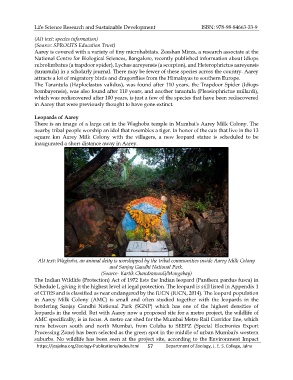
               There is an image of a large cat in the Waghoba temple in Mumbai's Aarey Milk Colony. The
               nearby tribal people worship an idol that resembles a tiger. In honor of the cats that live in the 13
               square  km  Aarey  Milk  Colony  with  the  villagers,  a  new  leopard  statue  is  scheduled  to  be
               inaugurated a short distance away in Aarey.


                 Alt text: Waghoba, an animal deity is worshipped by the tribal communities inside Aarey Milk Colony
                                               and Sanjay Gandhi National Park.
                                           (Source- Kartik Chandramouli/Mongabay)
               The Indian Wildlife (Protection) Act of 1972 lists the Indian leopard (Panthera pardus fusca) in
               Schedule I, giving it the highest level of legal protection. The leopard is still listed in Appendix 1
               of CITES and is classified as near endangered by the IUCN (IUCN, 2014). The leopard population
               in  Aarey  Milk  Colony  (AMC)  is  small  and  often  studied  together  with  the  leopards  in  the
               bordering  Sanjay  Gandhi  National  Park  (SGNP)  which  has  one  of  the  highest  densities  of
               leopards in the world. But with Aarey now a proposed site for a metro project, the wildlife of
               AMC specifically, is in focus. A metro car shed for the Mumbai Metro Rail Corridor line, which
               runs  between  south  and  north  Mumbai,  from  Colaba  to  SEEPZ  (Special  Electronics  Export
               Processing Zone) has been selected as the green spot in the middle of urban Mumbai's western
               suburbs.  No  wildlife has  been  seen  at  the  project  site,  according  to  the  Environment  Impact
                https://jesjalna.org/Zoology-Publications/index.html   57   Department of Zoology, J. E. S. College, Jalna

