


Page 15 - RUT Publisher
P. 15
Life Science Research and Sustainable Development                                   ISBN: 978-98-84663-33-9

                                amarant (1), barley (26), brome grass (1), buckthorn (1), buckwheat (8),
                                castor bean (1), chamomile (1), chrysanthemum (17), common bean (4),
                                cotton (2), cress (1), cucumber (1), durra (1), faba bean (4), fig (1),
                 USSR           flax/linseed (3), fodder beet (5), grape (1), iris (5), kale (1), lettuce (1),   204
                                maize (12), millet (3), oat (3), onion (1), pea (8), pepper (1), plavine (1),
                                pomegranate (2), poplar (1), rapeseed (2), raspberry (1), rice (6), sainfoin
                                (2), sorghum (1), sour cherry (4), soybean (9), sudan grass (1), sunflower
                                (1), tobacco (4), tomato (2), vetch (1), watermelon (1), wheat (36), white
                                lupin (13), yellow lupin (2)
                 Vietnam        groundnut (1), indian jujube (2), maize (2), peppermint (1), rice (18),    29
                                soybean (5),
                 Yugoslavia     pepper (1)                                                                 1

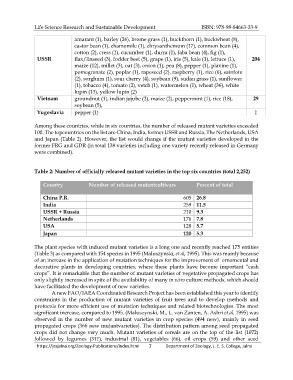
               Among these countries, while in six countries, the number of released mutant varieties exceeded
               100. The top countries on the list are China, India, former USSR and Russia, The Netherlands, USA
               and Japan (Table 2). However, the list would change if the mutant varieties developed in the
               former FRG and GDR (in total 138 varieties including one variety recently released in Germany
               were combined).


               Table 2: Number of officially released mutant varieties in the top six countries (total 2,252)

                   Country            Number of released mutant cultivars          Percent of total


                   China P.R.                                                 605  26.8
                   India                                                      259  11.5
                   USSR + Russia                                              210  9.3
                   Netherlands                                                176  7.8
                   USA                                                        128  5.7
                   Japan                                                      120  5.3

               The plant species with induced mutant varieties is a long one and recently reached 175 entities
               (Table 3) as compared with 154 species in 1995 (Maluszynski, et al, 1995). This was mainly because
               of an increase in the application of mutation techniques for the improvement of  ornamental and
               decorative  plants  in  developing  countries,  where  these  plants  have  become  important  “cash
               crops”. It is remarkable that the number of mutant varieties of vegetative propagated crops has
               only slightly increased in spite of the availability of many in vitro culture methods, which should
               have facilitated the development of new varieties.
                       A new FAO/IAEA Coordinated Research Project has been established this year to identify
               constraints  in  the  production  of  mutant  varieties  of  fruit  trees  and  to  develop  methods  and
               protocols for more efficient use of mutation techniques and related biotechnologies. The most
               significant increase, compared to 1995, (Maluszynski, M., L. van Zanten, A. Ashri et al, 1995) was
               observed  in  the  number  of  new  mutant  varieties  in  crop  species  (494  new),  mainly  in  seed
               propagated crops (366 new mutant varieties). The distribution pattern among seed propagated
               crops did not change very much. Mutant varieties of cereals are on the top of the list (1072)
               followed  by  legumes  (311),  industrial  (81),  vegetables  (66),  oil  crops  (59)  and  other  seed
                https://jesjalna.org/Zoology-Publications/index.html   7   Department of Zoology, J. E. S. College, Jalna

