


Page 10 - RUT Publisher
P. 10
Life Science Research and Sustainable Development                                   ISBN: 978-98-84663-33-9

               The term “mutation” used in 1900 by Hugo de Vries, to describe phenotypic changes which were
               heritable. However, the term ‘mutation’ is now used in a rather strict sense to cover only those
               changes which alter the chemical structure of a gene at molecular level, are commonly called gene
               mutations or point mutations. Structural changes in the chromosomes viz., deletions, duplication,
               inversions and translocations also bring about phenotypic changes in plants and animals, are
               called chromosomal mutations.
                       Mutations are classified depending upon the magnitude of phenotypic effect produced
               by them into two groups (Gaul 1964).
               (i)    Macro  mutations:  In  this  type  produce  a  large  recognizable  phenotype  effect  on
                      individual plants. These are oligogenic in nature and can be easily selected in the M2
                      generation
               (ii)   Micro mutations: These types of mutations produce a small phenotypic effect that can be
                      identified only on the basis of a population. These are polygenic in nature and selection
                      for such mutations can be delayed till M3 or later generations.
                      Types  of  Mutagens:  In  mutation  breeding  the  agents  available  and  responsible  for
                      induction of mutations called mutagens. They are categorized into two classes: a) Physical
                      and b) Chemical mutagens.
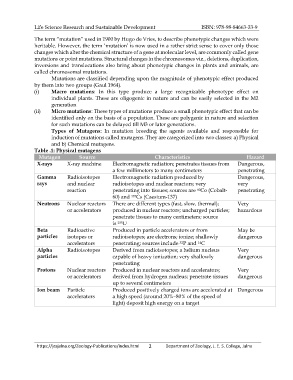
               Table .1: Physical mutagens
                 Mutagen          Source                          Characteristics                       Hazard
                 X-rays      X-ray machine      Electromagnetic radiation; penetrates tissues from   Dangerous,
                                                a few millimeters to many centimeters               penetrating
                 Gamma       Radioisotopes      Electromagnetic radiation produced by               Dangerous,
                 rays        and nuclear        radioisotopes and nuclear reactors; very            very
                             reaction           penetrating into tissues; sources are  Co (Cobalt-  penetrating
                                                                                   60
                                                60) and  Cs (Caesium-137)
                                                        137
                 Neutrons    Nuclear reactors   There are different types (fast, slow, thermal);    Very
                             or accelerators    produced in nuclear reactors; uncharged particles;   hazardous
                                                penetrate tissues to many centimeters; source
                                                is  U
                                                  235
                 Beta        Radioactive        Produced in particle accelerators or from           May be
                 particles   isotopes or        radioisotopes; are electrons; ionize; shallowly     dangerous
                             accelerators       penetrating; sources include  P and  C
                                                                                    14
                                                                            32
                 Alpha       Radioisotopes      Derived from radioisotopes; a helium nucleus        Very
                 particles                      capable of heavy ionization; very shallowly         dangerous
                                                penetrating
                 Protons     Nuclear reactors   Produced in nuclear reactors and accelerators;      Very
                             or accelerators    derived from hydrogen nucleus; penetrate tissues    dangerous
                                                up to several centimeters
                 Ion beam    Particle           Produced positively charged ions are accelerated at  Dangerous
                             accelerators       a high speed (around 20%–80% of the speed of
                                                light) deposit high energy on a target


                https://jesjalna.org/Zoology-Publications/index.html   2   Department of Zoology, J. E. S. College, Jalna

