


Page 12 - RUT Publisher
P. 12
Life Science Research and Sustainable Development                                   ISBN: 978-98-84663-33-9

               conventional plant breeding and directly contribute toward the conservation and use of plant
               genetic resources.
                       To  induce  genetic  variability  in  various  crops  different  mutagens  have  been  used  by
               various breeders. Since the discovery of mutation effect of X-rays in the 1920s Lewis John Stadler
               has recognized induction of mutation as a potential technique for crop improvement (Shu et al.,
               2012). The first disease resistant mutant was reported in barley in 1942 (Usharani & Ananda
               Kumar, 2015). This finding leads to further work on mutagenesis and helps to develop and release
               different mutant of several crops.
                       Chemical mutagens have been successfully employed in mutation breeding programs to
               artificially generate variations for the development of new varieties with improved traits, such as
               an increased yield, reduced plant height, resistance to disease and other desirable agronomic
               characters (Khursheed, et al., 2015, Tantray et al., 2017). Chemical mutagens primarily induce
               single point mutation so, it has been most commonly used in reverse genetic studies, and current
               technologies can also be easily adapted for their discovery (Jankowicz-Cieslak & Till, 2016).
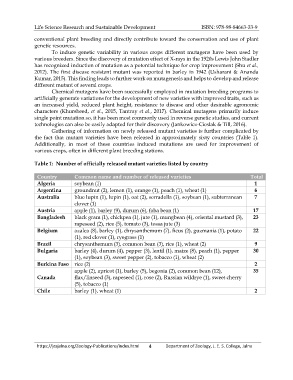
                       Gathering of information on newly released mutant varieties is further complicated by
               the  fact  that  mutant  varieties  have  been  released  in  approximately  sixty  countries  (Table  1).
               Additionally,  in  most  of  these  countries  induced  mutations  are  used  for  improvement  of
               various crops, often in different plant breeding stations.

               Table 1:  Number of officially released mutant varieties listed by country

                 Country        Common name and number of released varieties                              Total
                 Algeria        soybean (1)                                                                1
                 Argentina      groundnut (2), lemon (1), orange (1), peach (1), wheat (1)                 6
                 Australia      blue lupin (1), lupin (1), oat (2), serradella (1), soybean (1), subterranean   7
                                clover (1)
                 Austria        apple (1), barley (9), durum (6), faba bean (1)                            17
                 Bangladesh     black gram (1), chickpea (1), jute (1), mungbean (4), oriental mustard (3),   23
                                rapeseed (2), rice (5), tomato (3), tossa jute (3)
                 Belgium        azalea (8), barley (1), chrysanthemum (7), ficus (2), guzmania (1), potato   22
                                (1), red clover (1), ryegrass (1)
                 Brazil         chrysanthemum (3), common bean (3), rice (1), wheat (2)                    9
                 Bulgaria       barley (4), durum (4), pepper (3), lentil (1), maize (8), peach (1), pepper   30
                                (1), soybean (3), sweet pepper (2), tobacco (1), wheat (2)
                 Burkina Faso  rice (2)                                                                    2
                                apple (2), apricot (1), barley (5), begonia (2), common bean (12),         35
                 Canada         flax/linseed (3), rapeseed (1), rose (2), Russian wildrye (1), sweet cherry
                                (5), tobacco (1)
                 Chile          barley (1), wheat (1)                                                      2


                https://jesjalna.org/Zoology-Publications/index.html   4   Department of Zoology, J. E. S. College, Jalna

