


Page 11 - RUT Publisher
P. 11
Life Science Research and Sustainable Development                                   ISBN: 978-98-84663-33-9

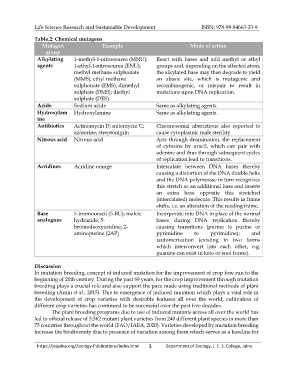
               Table.2: Chemical mutagens
                   Mutagen                  Example                             Mode of action
                    group
                 Alkylating     1-methyl-1-nitrosourea (MNU);     React  with  bases  and  add  methyl  or  ethyl
                 agents         1-ethyl-1-nitrosourea (ENU);      groups and, depending on the affected atom,
                                methyl methane sulphonate         the alkylated base may then degrade to yield
                                (MMS); ethyl methane              an  abasic  site,  which  is  mutagenic  and
                                sulphonate (EMS); dimethyl        recombinogenic,  or  mispair  to  result  in
                                sulphate (DMS); diethyl           mutations upon DNA replication.
                                sulphate (DES).
                 Azide          Sodium azide                      Same as alkylating agents.
                 Hydroxylam     Hydroxylamine                     Same as alkylating agents.
                 ine
                 Antibiotics    Actinomycin D; mitomycin C;       Chromosomal  aberrations  also  reported  to
                                azaserine; streptonigrin          cause cytoplasmic male sterility.
                 Nitrous acid   Nitrous acid                      Acts through deamination, the replacement
                                                                  of  cytosine  by  uracil,  which  can  pair  with
                                                                  adenine and thus through subsequent cycles
                                                                  of replication lead to transitions.
                 Acridines      Acridine orange                   Intercalate  between  DNA  bases  thereby
                                                                  causing a distortion of the DNA double helix
                                                                  and the DNA polymerase in turn recognizes
                                                                  this stretch as an additional base and inserts
                                                                  an  extra  base  opposite  this  stretched
                                                                  (intercalated) molecule. This results in frame
                                                                  shifts, i.e. an alteration of the reading frame.
                 Base           5-bromouracil (5-BU); maleic      Incorporate into DNA in place of the normal
                 analogues      hydrazide; 5-                     bases  during  DNA  replication  thereby
                                bromodeoxyuridine; 2-             causing  transitions  (purine  to  purine  or
                                aminopurine (2AP)                 pyrimidine      to     pyrimidine);     and
                                                                  tautomerization  (existing  in  two  forms
                                                                  which  interconvert  into  each  other,  e.g.
                                                                  guanine can exist in keto or enol forms).

               Discussion
               In mutation breeding, concept of induced mutation for the improvement of crop fore run to the
               beginning of 20th century. During the past 89 years, for the crop improvement through mutation
               breeding plays a crucial role and also support the pace made using traditional methods of plant
               breeding (Amin et al., 2015). Due to emergence of induced mutation which plays a vital role in
               the  development  of  crop  varieties  with  desirable  features  all  over  the  world,  cultivation  of
               different crop varieties has continued to be successful over the past five decades.
                       The plant breeding programs due to use of induced mutants across all over the world has
               led to official release of 3,362 mutant plant varieties from 240 different plant species in more than
               75 countries throughout the world (FAO/IAEA, 2020). Varieties developed by mutation breeding
               increase the biodiversity due to presence of variation among them which serves as a baseline for


                https://jesjalna.org/Zoology-Publications/index.html   3   Department of Zoology, J. E. S. College, Jalna

