


Page 20 - RUT Publisher
P. 20
Life Science Research and Sustainable Development                                   ISBN: 978-98-84663-33-9

                    Vitis vinifera L.                                    grape                  1
                    Weigela sp.                                         weigela                 3
                    Zea mays L.                                          maize                 68
                    Ziziphus mauritiana Lam.                         indian jujube              2

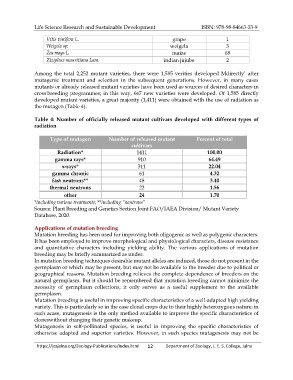
               Among  the  total  2,252  mutant  varieties,  there  were  1,585  verities  developed  Mdirectly’  after
               mutagenic  treatment  and  selection  in  the  subsequent  generations.  However,  in  many  cases
               mutants or already released mutant varieties have been used as sources of desired characters in
               cross breeding programmes; in this way, 667 new varieties were developed. Of 1,585 directly
               developed mutant varieties, a great majority (1,411) were obtained with the use of radiation as
               the mutagen (Table 4).

               Table  4:  Number  of  officially  released mutant  cultivars  developed  with  different  types  of
               radiation

                      Type of mutagen         Number of released mutant            Percent of total
                                                        cultivars
                         Radiation*                       1411                          100.00
                        gamma rays*                        910                          64.49
                           x-rays*                         311                          22.04
                       gamma chronic                       61                            4.32
                       fast neutrons**                     48                            3.40
                      thermal neutrons                     22                            1.56
                            other                          24                            1.70
               *including various treatments; **including “neutrons”
               Source: Plant Breeding and Genetics Section     Joint FAO/IAEA Division/ Mutant Variety
               Database, 2020.

               Applications of mutation breeding
               Mutation breeding has been used for improving both oligogenic as well as polygenic characters.
               It has been employed to improve morphological and physiological characters, disease resistance
               and  quantitative  characters  including  yielding  ability.  The  various  applications  of  mutation
               breeding may be briefly summarized as under.
               In mutation breeding techniques desirable mutant alleles are induced, those do not present in the
               germplasm or which may be present, but may not be available to the breeder due to political or
               geographical reasons. Mutation breeding relieves the complete dependence of breeders on the
               natural germplasm. But it should be remembered that mutation breeding cannot minimize the
               necessity  of  germplasm  collections;  it  only  serves  as  a  useful  supplement  to  the  available
               germplasm.
               Mutation breeding is useful in improving specific characteristics of a well-adapted high yielding
               variety. This is particularly so in the case clonal crops due to their highly heterozygous nature; in
               such acase, mutagenesis is the only method available to improve the specific characteristics of
               cloneswithout changing their genetic makeup.
               Mutagenesis  in  self-pollinated  species,  is  useful  in  improving  the  specific  characteristics  of
               otherwise adapted and superior varieties. However, in such species mutagenesis may not be


                https://jesjalna.org/Zoology-Publications/index.html   12   Department of Zoology, J. E. S. College, Jalna

