


Page 36 - RUT Publisher
P. 36
Life Science Research and Sustainable Development                                   ISBN: 978-98-84663-33-9

               2.2 Root and rhizospheric soil sample collection
               The  roots  of  the  plants  was  collected  along with  the  rhizospheric  soil  sample  of  Heteropogon
               contortus L. widely growing in area of Mauli Mahavidyalaya, Wadala , N. Solapur , without any
               harm  to  the  root  system.  The  collected  material  brought  into  laboratory,  washed  the  roots
               thoroughly with tap water until the removal of adhering soil. The washed roots were cut into 1cm
               length  each.  The  arbuscular  mycorrhizal  root  colonization  was  studied  by  using  the  method
               suggested  by  Phillips  and  Haymann  (1970).  The  root  segments  were  kept  in  10%  KOH  and
               autoclaved it for 15 minutes at proper pressure. After that KOH was removed and dipped these
               root segments into 1N HCL for 5 minutes. After that root segments were stained in cotton blue
               with  lactophenol  overnight.  In  next  day  such  stained  root  segments  were  screened  under
               microscope, for its arbuscular mycorrhizal root colonization.
                       The whole mount of root segments showed presence of arbuscles, vesicles and mycelium
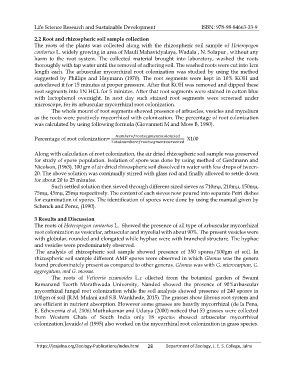
               as the roots were positively mycorrhizal with colonization. The percentage of root colonization
               was calculated by using following formula (Giovanneti M and Moss B, 1980).

               Percentage of root colonization=       X100


               Along with calculation of root colonization, the air dried rhizospheric soil sample was preserved
               for study of spore population. Isolation of spore was done by using method of Gerdmann and
               Nicolson, (1963). 100 gm of air dried rhizospheric soil dissolved in water with few drops of tween-
               20. The above solution was continually stirred with glass rod and finally allowed to settle down
               for about 20 to 25 minutes.
                       Such settled solution then sieved through different sized sieves as 710mµ, 210mµ, 150mµ,
               75mµ, 45mµ, 25mµ respectively. The content of each sieves now poured into separate Petri dishes
               for examination of spores. The identification of spores were done by using the manual given by
               Schenck and Perez, (1990).

               3 Results and Discussion
               The roots of Heteropogon contortus L.  Showed the presence of all type of arbuscular mycorrhizal
               root colonization as vesicular, arbuscular and mycelial with about 90%. The present vesicles were
               with globular, rounded and elongated while hyphae were with branched structure. The hyphae
               and vesicles were predominately observed.
                The  analysis  of  rhizospheric  soil  sample  showed  presence  of  350  spores/100gm  of  soil.  In
               rhizospheric soil sample different AMF spores were observed in which Glomus was the genera
               found predominately present as compared to other generas. Glomus was with G. microcarpum, G.
               aggregatum, and G. mossae.
                       The  roots  of  Vetiveria  zizanioides  L.c  ollected  from  the  botanical  garden  of  Swami
               Ramanand  Teerth  Marathwada  University,  Nanded  showed  the  presence  of  90%arbuscular
               mycorrhizal fungal root colonization while the soil analysis showed presence of 240 spores in
               100gm of soil (R.M. Mulani and S.B. Wankhede, 2015). The grasses show fibrous root system and
               are efficient in nutrient absorption. However some grasses are heavily mycorrhizal (de la Pena,
               E. Echeverria et al, 2006).Muthukumar and Udaiya (2000) noticed that 53 grasses were collected
               from  Western  Ghats  of  South  India  only  18  species  showed  arbuscular  mycorrhizal
               colonization.Javaidet al (1995) also worked on the mycorrhizal root colonization in grass species.


                https://jesjalna.org/Zoology-Publications/index.html   28   Department of Zoology, J. E. S. College, Jalna

