


Page 40 - RUT Publisher
P. 40
Life Science Research and Sustainable Development                                   ISBN: 978-98-84663-33-9

               biological functions. They are ubiquitous in their distribution and there is really no satisfactory
               scheme of classifying them. The largest groups of proteins are the enzyme proteins provide rich
               environment for the nourishment of cestodes. The cestodes utilize different degrees of protein for
               producing energy. Literature reveals that the parasites able to adapt themselves to the parasitic
               mode of life only due to protein usually constitutes between 20 and 40 % of the dry weight have
               been reported (John Barrett 1981) . The higher content of lipid is found in older proglottids (Brand
               and Van T. 1952) . It is revealed from the present study that there is high content of lipids in the
               parasites and the parasites are taking advantage of host by absorbing most of the nourishing
               material. The present investigation deals with the biochemical studies of  Avitellina cestode in
               ruminants Capra hircus.

               Material and Methods
               The  cestodes  were collected  from  the  alimentary  tract  of  Capra  hircus  and  then  washed  with
               distilled water. Collected cestodes were dried on the blotting paper keeping them to remove
               excess water and transferred to watch glass and weighed on sensitive balance. After 50-60 C  for
                                                                                                         o
               24 hrs, the dry weight was also taken. The estimation of protein content in the cestode parasites
               were carried out by Lowry’s method (1951), the glycogen estimation were carried out by Kemp
               et al. (1954) method and lipid estimation by Folch et al (1957) method.

               Result and Discussion-
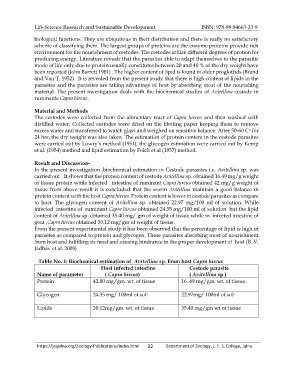
               In the present investigation ,biochemical estimation in Cestode parasites i.e. Avitellina sp. was
               carried out  . It shows that the protein content of cestode Avitellina sp. obtained 16.49 mg/g weight
               of tissue protein while infected   intestine of ruminant Capra hircus obtained 42 mg/g weight of
               tissue from  above  result  it is concluded that  the  worm  Avitellina  maintain a  good  balance  in
               protein content with the host Capra hircus. Protein content is lower in cestode parasites as compare
               to  host.  The  glycogen  content  of  Avitellina  sp.  obtained  22.97  mg/100  ml  of  solution.  While
               infected  intestine of  ruminant Capra hircus obtained 24.35 mg/100 ml of solution  but the lipid
               content of Avitellina sp. obtained 35.40 mg/ gm of weight of tissue while in  infected intestine of
               goat ,Capra hircus obtained 30.12 mg/gm of weight of tissue.
               From the present experimental study it has been observed that the percentage of lipid is high in
               parasites as compared to protein and glycogen. These parasites absorbing most of nourishment
               from host and fulfilling its need and causing hindrance in the proper development of  host (B. V.
               Jadhav et al. 2008)

                  Table No. 1: Biochemical estimation of  Avitellina sp. From host Capra hircus
                                                     Host infected intestine         Cestode parasite
                 Name of parameter               ( Capra hircus)                   ( Avitellina sp.)
                 Protein                42.00 mg/gm. wt. of tissue           16..49 mg/gm. wt. of tissue

                 Glycogen               24.35 mg/ 100ml of sol               22.97mg/ 100ml of sol
                                                              n
                                                                                                   n

                 Lipids                 30.12mg/gm  wt. of tissue            35.40 mg/gm wt of tissue


                https://jesjalna.org/Zoology-Publications/index.html   32   Department of Zoology, J. E. S. College, Jalna

