


Page 151 - RUT Publisher
P. 151
Life Science Research and Sustainable Development                                   ISBN: 978-98-84663-33-9

               management  and  product  sale.  Agriculture  4.0  suggest  the  optimum  input  of  irrigation,
               fertilizers, and pesticides targeting very specific part of land.


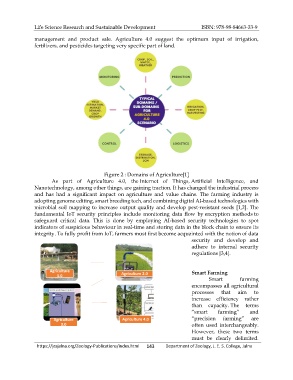
                                            Figure 2 : Domains of Agriculture[1]
                       As  part  of  Agriculture  4.0,  the Internet  of  Things, Artificial  Intelligence,  and
               Nanotechnology, among other things, are gaining traction. It has changed the industrial process
               and  has  had  a  significant  impact  on  agriculture  and  value  chains.  The  farming  industry  is
               adopting genome editing, smart breeding tech, and combining digital AI-based technologies with
               microbial soil mapping to increase output quality and develop pest-resistant seeds [1,2]. The
               fundamental  IoT  security  principles  include  monitoring  data  flow  by encryption  methods to
               safeguard  critical  data.  This  is  done  by  employing  AI-based  security  technologies  to  spot
               indicators of suspicious behaviour in real-time and storing data in the block chain to ensure its
               integrity. To fully profit from IoT, farmers must first become acquainted with the notion of data
                                                                                 security  and  develop  and
                                                                                 adhere  to  internal  security
                                                                                 regulations [3,4].


                      Agriculture                   Agriculture 2.0              Smart Farming
                         1.0
                                                                                        Smart        farming
                                                                                 encompasses all agricultural
                                                                                 processes   that   aim    to
                                                                                 increase  efficiency  rather
                                                                                 than  capacity. The  terms
                                                                                 “smart     farming”     and

                       Agriculture                  Agriculture 4.0              “precision   farming”    are
                          3.0                                                    often  used  interchangeably.
                                                                                 However,  these  two  terms
                                                                                 must  be  clearly  delimited.

                https://jesjalna.org/Zoology-Publications/index.html   143   Department of Zoology, J. E. S. College, Jalna

