


Page 133 - RUT Publisher
P. 133
Life Science Research and Sustainable Development                                   ISBN: 978-98-84663-33-9

               litter), moisture (20g %) and temperature (25+2°C). Earthworms were removed from culture pots
               and kept half immersed in glass petriplates containing 30ml of tap water in 25+2°C temperature
               for 24 hours to evacuate their guts (Dash and Patra, 1977). The study was carried out in plastic
               culture pots under laboratory conditions following the protocol of Panda and Sahu (2002). In
               brief, three heavy metals namely mercuric chloride (HgCl2), Copper sulphate (CuSO4) and Zinc
               sulphate (ZnSO4) respectively used as the test chemicals were obtained from Ranbaxy Chemicals
               Ltd. The pesticides were chosen on the basis of their extensive use in this area.
                       Toxicity tests using of adult (10cm length and 3 gm in weight) Perionyx excavatus were
               conducted for 24 to 96 hours with different concentrations of each heavy metal (mg/kg dry soil
               equivalent)  applied  to  the  soil  as  per  the  method  used  by  Dash  and  Patra  (1977).  The
               concentration  were  prepared  in  dilution  of  acetone  and  sprayed  on  the  soil  surface.  After
               evaporation  of  the  solvent,  the  treated  soil  was  thoroughly  mixed  to  distribute  the  pesticide
               evenly and enough water was added to bring the moisture content up to the field capacity. The
               same procedure with pure acetone was applied to prepare the controls. Ten healthy gut cleared
               earthworm were added to each pot. The experiment was maintained at 20 % soil moisture at 250
               +2°C soil temperatures. Earthworm deaths were recorded and probit method of Finney (1971)
               was followed to calculate LD50 value for adult earthworm, Panda and Sahu (2002). Calculation
               of the Regression line: Assessment of median lethal dose LD50
                       The experiment was carried out for finding the range of concentrations for confirmatory
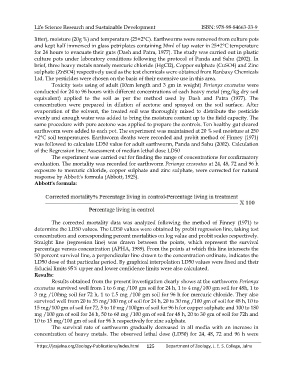
               evaluation. The mortality was recorded for earthworm Perionyx excavatus at 24, 48, 72 and 96 h
               exposure to mercuric chloride, copper sulphate and zinc sulphate, were corrected for natural
               response by Abbott's formula (Abbott, 1925).
               Abbott's formula:


                       The  corrected  mortality  data  was  analyzed  following  the  method  of  Finney  (1971)  to
               determine the LD50 values. The LD50 values were obtained by probit regression line, taking test
               concentration and corresponding percent mortalities on log value and probit scales respectively.
               Straight  line  (regression  line)  was  drawn  between  the  points,  which  represent  the  survival
               percentage versus concentration (APHA, 1989). From the points at which this line intersects the
               50 percent survival line, a perpendicular line drawn to the concentration ordinate, indicates the
               LD50 dose of that particular period. By graphical interpolation LD50 values were fixed and their
               fiducial limits 95% upper and lower confidence limits were also calculated.
               Results:
                       Results obtained from the present investigation clearly shows at the earthworm Perionyx
               excavatus survived well from 1 to 6 mg /100 gm soil for 24 h, 1 to 4 mg/100 gm soil for 48h, 1 to
               3 mg /100mg soil for 72 h, 1 to 1.5 mg /100 gm soil for 96 h for mercuric chloride. They also
               survived well from 20 to 55 mg/100 mg of soil for 24 h, 20 to 30 mg /100 gm of soil for 48 h, 10 to
               15 mg/100 gm of soil for 72, 5 to 10 mg /100gm of soil for 96 h for copper sulphate and 100 to 180
               mg /100 gm of soil for 24 h, 50 to 60 mg /100 gm of soil for 48 h, 20 to 30 gm of soil for 72h and
               10 to 15 mg/100 gm of soil for 96 h respectively for zinc sulphate.
                       The  survival  rate  of  earthworm  gradually  decreased  in  all  media  with  an  increase  in
               concentration of heavy metals. The observed lethal dose (LD50) for 24, 48, 72 and 96 h were


                https://jesjalna.org/Zoology-Publications/index.html   125   Department of Zoology, J. E. S. College, Jalna

