


Page 92 - RUT Publisher
P. 92
Life Science Research and Sustainable Development                                   ISBN: 978-98-84663-33-9

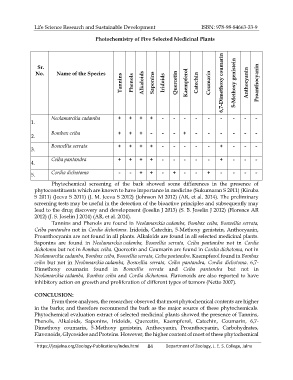
                                         Photochemistry of Five Selected Medicinal Plants


                  Sr.
                No.       Name of the Species
                                                    Tannins   Phenols   Alkaloids   Saponins   Iridoids   Quercetin   Kaempferol   Catechin   Coumarin   6,7-Dimethoxy coumarin   5-Methoxy genistein   Anthocyanin   Proanthocyanin


                      Neolamarckia cadamba        +    +   +    +    -   -    -    -    -    -    -    -    -
              1.

                      Bombax ceiba                +    +   +    -    -   -    +    -    -    -    -    -    -
              2.
                      Boswellia serrata           +    +   +    +    -   -    -    -    -    +    -    -    -
              3.

                      Ceiba pantandra             +    +   +    +    -   -    -    -    -    +    -    -    -
              4.

              5.      Cordia dichotoma             -   -   +    +    -   +    -    -    +    -    -    -    -
                       Phytochemical  screening  of  the  bark  showed  some  differences  in  the  presence  of
               phytoconstituents which are known to have importance in medicine (Sukumaran S 2011) (Kiruba
               S 2011) (Jeeva S 2011) (J. M. Jeeva S 2012) (Johnson M 2012) (AR, et al. 2014). The preliminary
               screening tests may be useful in the detection of the bioactive principles and subsequently may
               lead to the drug discovery and development (Joselin J 2013) (S. B. Joselin J 2012) (Florence AR
               2012) (J. S. Joselin J 2014) (AR, et al. 2014).
                       Tannins and Phenols are found in Neolamarckia cadamba, Bombax ceiba, Boswellia serrata,
               Ceiba pantandra not in Cordia dichotoma. Iridoids, Catechin, 5-Methoxy genistein, Anthocyanin,
               Proanthocyanin are not found in all plants. Alkaloids are found in all selected medicinal plants.
               Saponins  are  found  in  Neolamarckia cadamba,  Boswellia  serrata,  Ceiba  pantandra  not  in  Cordia
               dichotoma but not in Bombax ceiba. Quercetin and Coumarin are found in Cordia dichotoma, not in
               Neolamarckia cadamba, Bombax ceiba, Boswellia serrata, Ceiba pantandra. Kaempferol found in Bombax
               ceiba  but  not  in  Neolamarckia cadamba,  Boswellia  serrata,  Ceiba  pantandra,  Cordia  dichotoma.  6,7-
               Dimethoxy  coumarin  found  in  Boswellia  serrata  and  Ceiba  pantandra  but  not  in
               Neolamarckia cadamba, Bombax ceiba and Cordia dichotoma. Flavonoids are also reported to have
               inhibitory action on growth and proliferation of different types of tumors (Netto 2007).

               CONCLUSION:
                       From these analyses, the researcher observed that most phytochemical contents are higher
               in the barks; and therefore recommend the bark as the major source of these phytochemicals.
               Phytochemical evaluation extract of selected medicinal plants showed the presence of Tannins,
               Phenols,  Alkaloids,  Saponins,  Iridoids,  Quercetin,  Kaempferol,  Catechin,  Coumarin,  6,7-
               Dimethoxy  coumarin,  5-Methoxy  genistein,  Anthocyanin,  Proanthocyanin,  Carbohydrates,
               Flavonoids, Glycosides and Proteins. However, the higher content of most of these phytochemical


                https://jesjalna.org/Zoology-Publications/index.html   84   Department of Zoology, J. E. S. College, Jalna

