


Page 113 - RUT Publisher
P. 113
Life Science Research and Sustainable Development                                   ISBN: 978-98-84663-33-9

               MATERIAL AND METHODS
               The present study was carried out through extensive field visit from July 2019 to March 2020.
               During field survey the plants had been observed at flowering stages as far as possible from their
               natural habitat. They were identified with standard flora (Hooker, 1982; Naik, 1998).
               Study area
               Jalna is a district in the state of Maharashtra with its district headquarters situated at 19.8410°N
               75.8864°E. It has an average elevation of 508 m (1,667 ft), on the banks of the Kundalika River.
               Jalna education society’s college, Jalna is located near the police training center, Jalna. The Jalna
               Education Society, college Jalna is one of the institute of Marathwada region was formed in 1957
               with an aim to provide higher education and research work to encourage the students of the town
               and  nearby  rural  areas  in  various  science  disciplines.  In  fact,  establishment  of  a  full-fledged
               college was a long felt need of Jalna. It is sprawled over area of 16 acres in picturesque landmass
               with pollution free environment. An attempt was made to explore the flowering plant diversity
               of the college campus. The college has a set of beautiful old buildings along with play ground,
               gardens  and  teak  plantation.  The  campus  sprawled  over  an  area  of  16  acres  in  picturesque
               landmass.

               RESULTS AND DISCUSSION
               The present floristic survey deals with the documentation of eco friendly college campus which
               is associated with rich of flora of herbs, climbers, shrubs and trees. This taxonomic survey of
               campus was carried out from different localities of campus. There are many socio-economical,
               medicinal and ornamental plants grown in this campus. Most of plants are naturally grown and
               many of are planted obviously for beautifulness and to control the pollution.
               All  the  visits  were  made  during  the  flowering  and  fruiting  seasons.  During  these  visits,  146
               species of plants belonging to 25 families were collected and identified from the college campus.
               The  dominant  families  in  the  campus  representing  the  maximum  number  of  species  were
               Fabaceae, Asteraceae, Malvaceae, Portulacaceae, Lythraceae, Rutaceae, Sapotaceae,  Meliaceae,
               Myrtaceae  and Apocynaceae. Whereas the rest of the families were represented by only one
               species in the study area Jalna education society’s college campus had good biodiversity.
               The  campus  is  home  to  many  trees,  herbs  and many  species  of  shrubs  growing  naturally in
               campus.  However  in  the  recent  past  due  to  various  activities  such  as  construction  and
               developmental works going on in the campus many species of trees have been cut down. This
               has  caused  huge  damage  to  the  floristic  composition  on  the  campus.  Despite  this  many
               herbaceous plants have exited this campus owing to these anthropogenic activities. Many species
               of exotic ornamental plants have been also planted in the campus for decorative and beauty
               purposes which have also caused disturbance in the natural  floristic  diversity  in  the campus
               therefore efforts  must  be  taken  for  ensuring ecological restoration and conservation of various
               species inhabiting the campus.

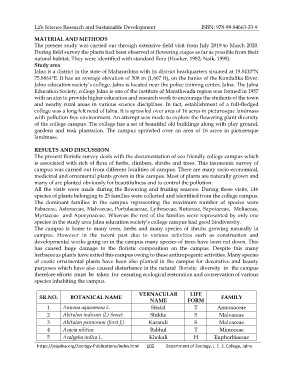
                                                           VERNACULAR           LIFE
                 SR.NO.       BOTANICAL NAME                                                 FAMILY
                                                                NAME           FORM
                     1     Annona aquaomosa L.                  Sitafal           T         Annonaceae
                     2     Abitulon indicum (L) Sweet.          Shikha            S          Malvaceae
                     3     Abitulon pannosum (forst f.)        Karandi            S          Malvaceae
                     4     Acacia nilitica                      Babhul            T          Mimoceae
                     5     Acalypha indica L.                  Khokali            H       Euphorbiaceae

                https://jesjalna.org/Zoology-Publications/index.html   105   Department of Zoology, J. E. S. College, Jalna

